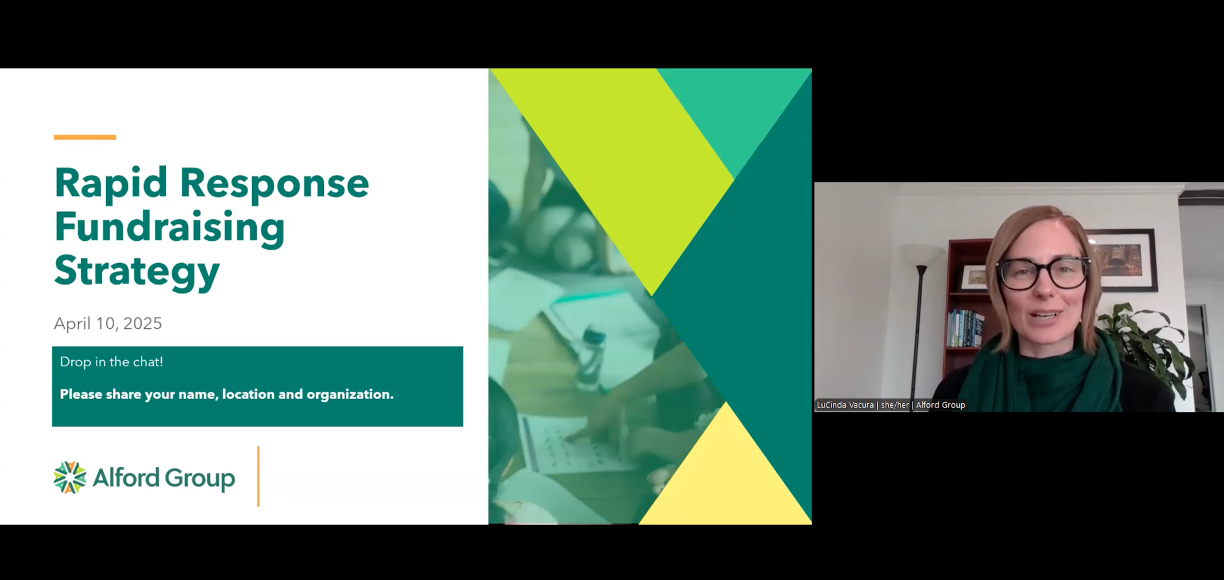
When a funding crisis hits, there becomes an immediate need to adjust. This comprehensive 60-minute webinar draws insights from our specialized Rapid Response Fundraising Strategy service designed specifically for nonprofit organizations navigating urgent financial challenges.
Our expert development consultants shared their recommendations and proven methodologies for:
- Identifying critical issues by assessing current and future fundraising scenarios
- Pivoting development strategies in real-time to address immediate needs
- Uncovering hidden funding opportunities within your existing donor base
- Sharing potential strategic shifts that maximize limited resources
- Converting crises into sustainable fundraising momentum
Following the presentation, our experts opened the floor for a Q&A session, addressing your organization’s specific challenges and providing tailored guidance for your unique circumstances. This webinar is ideal for nonprofit leaders, development directors, and board members who need concrete strategies to stabilize funding during unexpected shortfalls, navigate crises or capitalize on sudden growth opportunities. Join us to learn how on-the-ground counsel from experienced fundraising professionals can help your organization survive and thrive during financial uncertainty.
This comprehensive 60-minute webinar draws insights from our specialized Rapid Response Fundraising Strategy service designed specifically for nonprofit organizations navigating urgent financial challenges.
Transcript
Hello. Thank you so much for joining us. I’m Lucinda Vakura. I use she her pronouns. I’m the vice president of
0:09
business development and marketing with Alfred Group. Um I have short brown hair. I’m wearing dark rimmed glasses
0:15
and a teal scarf today and I’m sitting uh against a plant and a bookcase. Um
0:21
thank you so much for being here. Our our topic today is rapid response fundraising strategy. Before we dive in,
0:29
I want to tell you a little bit about Alfred Group and walk you through some housekeeping items. So, I realize many
0:35
of you are very familiar with Alfred Group, but for anybody who may not be, uh, we are a national fullervice
0:42
consultancy serving the nonprofit community. We offer six flagship services which are listed here on your
0:49
screen. Uh, we are proud member and supporter of AFP, the Association of Fundraising Professionals. We’re a
0:56
certified business um women’s business enterprise and a member of uh the Giving
1:02
Institute where our president and CEO Brenda Assari is currently serving as the chair. Um of course to find out more
1:09
information about Alford Group and who we are and what we do, you can check out our website which is in the bottom
1:14
leftand corner of the screen. It’s alford.com. I do want to take just a moment to
1:21
acknowledge the land on which we reside. You all are calling in from across the
1:26
country. Um, but I’m going to acknowledge Chicago, Illinois, which is where Alfred Group’s headquarters is
1:33
based. Chicago is located on the traditional unseated homelands of the Council of the Three Fires, the Jiuway,
1:40
Ottawa, and Padawani nations. Many other tribes such as the Miami, Ho Chunk,
1:45
Monomin, Sack, and Fox also call to this area home. The region has long been a
1:51
center for indigenous people to gather, trade, and maintain kinship ties. Um, a few webinar logistics. So
1:59
first of all um this webinar is being recorded and uh after the webinar
2:06
concludes within 24 hours you’ll receive an email from us that will include not
2:11
only the recording also the slide deck that you’ll see today as well as links
2:16
to the tools that we will go over. So you’ll have all of that at your uh
2:22
disposal very very soon after uh the webinar. Once the webinar concludes, you’ll be
2:28
prompted to complete a very short survey. We really appreciate your feedback. It’s short. It’s like four
2:33
questions and that really helps us plan for future events. We appreciate your
2:38
thoughts. Everyone today is in listenonly mode for the duration of the webinar. However, the chat is open. So,
2:45
as many of you have already found, um please uh introduce yourselves, say
2:51
hello, where you’re from, where you’re joining us from. um please use the chat
2:56
to um provide comments or reactions throughout the the presentation today. Um however, if you do have a question
3:02
that you want to ask to the presenters, if you could please instead use the Q&A
3:07
function. So, if you mouse over the bottom of your navigation bar, there’s a a separate Q&A icon that will open a
3:15
window and there you can chat and type your question that goes directly to the presenters and we’ll answer as many
3:21
questions as we can at the end of today’s presentation. So, with that, I would
3:28
love to um hand things over to our presenters today. um my colleagues and
3:35
friends Alexis Cook and Greg Whitney. Um thank you so much for presenting today
3:40
and I’ll I’ll let you introduce yourselves and kick things off. Thank you. Thank you, Lucinda.
3:45
We’re so excited to be here. My name is Alexis Cook, Alfred Group’s chief operating officer, and I have the
3:51
privilege of supporting our client partners as well. I spent 20 years leading and supporting development and
3:56
marketing teams uh across the nonprofit sector, but largely in Chicago. I use
4:02
she her pronouns. I am a white woman with dark blonde hair which I am currently wearing up. I have dark rimmed
4:08
glasses on, a red shirt, and a colorful scarf. And I am sitting in front of a blurred background. I’m also joining you
4:14
today from Santa Monica, California, which is the unseated ancestral home of the Tongva
4:21
peoples. My name is Greg Whitney and I’m a vice president with Alfred Group. I spent over 30 years in the nonprofit
4:28
sector and primarily in human services holding positions from senior program director
4:34
uh executive director to development director and worked directly in fundraising for over 20 years. I use
4:40
hehim pronouns and I’m a white man with gray hair a little missing on top and I have dark brown framed glasses with a
4:47
white blue striped shirt and uh black halfzip sweater on. I have a blurred background as well and I’m coming to you
4:53
from Seattle, Washington. the unseated ancestral home of the Co Salish
4:59
peoples. All right, we’d like to take a little time today uh to start off with
5:05
to learn a little bit more about what is your highest priority for why you are here today, which will aid us in how we
5:11
focus on providing you with the information today. So, if you could take a moment uh to answer this poll, our
5:18
rapid response poll question number one, which of these issues is the highest priority as you build your rapid
5:25
response fundraising strategy?
5:36
This is my favorite part, I think, Greg. Yeah, I really enjoy I really enjoy and
5:43
appreciate everyone’s participation in the polls,
5:50
right? Oh goodness. Yeah, a little bit of everything.
5:55
a little bit of everything, but I see replacing federal funding in your budget up towards the top as well as engaging
6:03
board members meaning meaningfully in fundraising efforts and just starting
6:08
that strategy. Yep. Absolutely.
6:13
Absolutely. Well, let’s let’s dive in and and just acknowledge. Let’s
6:19
acknowledge. If we’re finding ourselves needing rapid response fundraising strategies, it’s likely because your
6:26
organization is experiencing or seeking to prevent an impactful budget deficit caused by a loss of funding, as we just
6:33
saw in the poll, or the impact of the executive orders. And this is uh not
6:38
simply uh this fiscy year problem. Most likely this is probably a multi-year operational concern and issue. So your
6:46
strategy today needs to go beyond political um and the go beyond business as usual
6:53
as the nonprofit sector is under strain. Um we know that with the political and economic pressures, we’re
7:00
also seeing increased competition in the marketplace. And so there’s a lot of funding and programmatic uncertainty.
7:07
And we want to just say we know it’s difficult and exhausting, that this is a roller coaster. Uh there are moments of
7:13
opportunity which we want to talk about today, but it’s also um the highs and lows are coming quickly. And though we
7:20
would all love to have a magic wand and catapult ourselves out of this moment
7:25
and andor secure that elusive wonderful major gift um that’s going to save save
7:31
everything and mitigate the impact we’re experiencing. Um, we know a band-aid is not is not going to is not appropriate.
7:38
It’s not going to it’s not going to cut it. So, Greg and I uh want to validate
7:43
that fundraising alone is not enough and it’s not appropriate to expect fundraising to suddenly perform far
7:49
above and beyond the annual goals uh to save the day.
7:54
So, as we work to communicate with our external audiences, and we’re working to bolster fundraising, seek more immediate
8:02
dollars in the door, let’s also take this moment and educate our internal audiences and our volunteer leadership
8:09
so they understand that many small and large tactics are needed simultaneously to strengthen our philanthropic
8:15
practices and behaviors and ultimately build that momentum to secure the funding we need right now and shore us
8:22
up for greater sustainability in the future. So, let’s just take an emotional
8:29
thermometer uh and would you share with us how you’re feeling four months into this
8:35
changing environment?
8:46
I know this is a I mean that we know we know this is a really tough time and we’re all experiencing it, right, Greg? I mean, you’re experiencing at work, at
8:53
home, and your personal lives, and your communities.
9:03
Oh, thank you. Yeah. Well, I see I we see you. We
9:11
see you very anxious, but persisting and uncertain, but optimistic. We see you.
9:16
Um I think that’s where I sit. I don’t know, Greg, where would you put yourself? Yeah,
9:23
I’m I I would agree. I’m I’m that uncertain but optimistic person. I’ve been through a
9:30
few of these before, these challenging times and um you know, it’s just one of
9:35
those things that that comes comes across every so
9:40
often and we just happen to have aligned a lot of them together between the pandemic and where we’re at just a few
9:47
years later again. So I I I certainly feel that that angst that
9:54
others are experiencing. Yeah. And for those those um we we
10:01
really hope to have we want to share with you some thoughts today and then we really will hope to use most of our time for the question and answers. And so um
10:09
for for all of us who are feeling any anything along this range, please please share your questions with us as we go
10:15
along so we can address them and let’s keep the conversation going after as well. And I I just want to offer that
10:20
specifically to those who feel the sky is falling. Um so you know we’re here
10:25
for you um today of course but after.
10:31
All right. So, you know, though things may feel overwhelming, there’s a lot we
10:37
can do within philanthropy to meet this moment and set ourselves up for longer
10:42
term success. And the early signs that we are seeing in our practice and also historically speaking, private
10:49
philanthropy will look to lean in during these challenging times and try to
10:54
address increasing needs and financial gaps that are being left by the absence
10:59
of funding and especially the federal funding. both individuals and institutions are we’re seeing are
11:06
beginning to realize uh the magnitude of these public funding cuts and are trying
11:12
to understand what are the impacts for our country and our communities and how
11:17
are they needed to help address this new challenge. how charities, how we gather around
11:24
messaging the impacts to our services and those we serve and how we provide
11:30
proactive solutions will impact private philanthropy’s response over the next
11:35
few years. So, you know, how can we be sure we’re at the table? You know, as
11:42
Alexis pointed out, there is no magic wand. This takes cumulative actions uh
11:49
throughout all levels of an organization. This is not just the fundraiser’s job to solve. And a
11:55
willingness to um be honestly and transparent review our circumstances,
12:01
make organizational plans for different scenarios you may face and be nimble and
12:07
make course corrections as needed and to not bank on the one big thing. Um, these
12:13
are all actions that, you know, if we work and we work consistently through our strategies,
12:19
um, we can meet these challenges for needed rapid response fundraising and do it in a way that, um, is organized,
12:27
honest, and will build momentum beyond this emergency crisis that we’re facing.
12:32
We know this is not just probably a a three-month, a six-month. These are longer term issues that we’re facing
12:39
right now. Um, this is going to take a while for us to get through and we need to think through those strategies longer
12:46
term, not just for today. All
12:55
right. So, we wanted to take a little bit of time to talk about um building
13:01
momentum and accelerating a growth mindset. And at Alpha Group, we council taking four action steps for building
13:07
momentum and accelerating a growth mindset which is needed for rapid response fundraising. And the first is,
13:14
you know, truly let’s assess the current state. You know, identify organizational
13:20
scenarios and corresponding development projections and
13:25
activities from an informed that are informed by history and you know that
13:31
have some real analysis to them. Um, make sure you’re taking that time to
13:36
gather the information that’s clear and that is helping you develop the
13:41
potential scenarios you’re facing. Build and pivot fundraising strategies to meet the moment. Focus on
13:49
current relationships. Uh, start with those that are closest to your
13:55
organization. Um, we say build momentum from those in your inner circle and move
14:01
out. Convene critical conversations with those that are closest to you and maximize your fundraising efforts that
14:07
are already underway. And it looks like we got a little out of of sort here, but activate
14:12
a culture of philanthropy. Engage your board as part of the solution and leverage your
14:18
ambassador resources and networks. And then position authentic and clear
14:23
messaging. Center your messaging on strength-based positions. cascade, you know, cascade your
14:30
audience. Um, not all messages are the same for every every um segment of your donor
14:38
audience and emphasize valuebased philanthropy. So, what I’d like to do is
14:44
to turn it over to Alexis and we’ll start taking a little deeper dive, a little closer look to better understand
14:49
what each of these mean. You know, it’s it’s it’s almost appropriate that the animation was a
14:55
little off, Greg, because actually there’s there’s no one order for these things, but I will say I think it’s
15:00
really important that we start with assessing our current state of and current state and where we are today.
15:06
And so I want to dive uh deep deeper into that with you. Um so where are we
15:12
starting from and what are the known and anticipated factors that are impacting
15:18
your planning? So, we have a few thoughts for you here and I’ll share some additional context
15:23
and detail as we go through them. We do absolutely recommend affirming budget implications and using scenario planning
15:30
to intentionally and proactively plan at your highest level in in order to
15:36
identify and and recalibrate fundraising goals. your organization, we hope, is starting with a look at your operational
15:42
budget and this should then inform additional projections and um changes in
15:50
our in our targets. Uh, of course, specifically to identify where we need
15:56
short-term rapid response campaigns, initiatives, communication plans, etc.
16:01
We recently Alfred Group our colleagues recently hosted a webinar on scenario planning and we recommended
16:06
organizations consider outlining best baseline and worstc case scenarios a three scenario plan um to guide relevant
16:14
action steps and decision- making. These three scenarios can then inform uh your
16:21
projections which should ideally be multi-year and would be informed and
16:26
affirmed in partnership with the development team who are best positioned to assess the donor universe’s giving
16:32
behavior, your current data analysis, and then make informed decisions based on what has been effective and
16:38
ineffective in recent years, including, if appropriate, the pandemic.
16:46
So, Greg, I know you’re going to speak to this in more detail um when we when we chat about messaging in a moment, but
16:51
I just want to acknowledge that it’s important to consider how unstable and uncertain the financial picture is for
16:57
your organization through this data informed process because um that’s going to really help you identify that cascade
17:04
messaging framework. Um, we want to make sure that you are able to um, for
17:11
example, if you choose to map out a a best baseline and worstc case scenario
17:17
plan, you’re creating corresponding act activation plans based on those targets
17:23
and then aligning the communications matrix defined not just by those scenarios, but by who needs to hear what
17:30
within your audience. your staff and board need a different messaging, a
17:35
different level of messaging and transparency. Um, and then your broader constituents should be hearing from you
17:41
appropriate to how they are uh how they engage with you. And so we just wanted
17:47
to make sure to emphasize uh that your scenario planning doesn’t simply promote
17:53
projections and informed projections and decision-making. It will also inform your communication strategy.
18:00
Uh we do believe that by starting with this framework um we’ll provide you with
18:05
the um a look at what development and fundraising can achieve and that by doing so you’ll more quickly identify
18:11
opportunities within activities already started and under way um to to see where
18:17
you can leverage and pivot. We’re going to talk a little bit about that next. Um you’ll also be able to see where you may
18:23
have gaps in the resources needed to sustain your organization through this moment. And that should and must include
18:29
development staff time, talent, and the tools and resources leveraged for for
18:35
philanthropy. So if your if your bear with me just a second. There we
18:41
go. So if your team is short staffed due to transitions, there may be an opportunity to activate budgeted funds
18:47
from the open staff positions to hire councils interim staffing or bring in temp support. So, for example, when
18:52
you’re looking at the operational plan and budget, um if this is something that the fundraising team is experiencing, um
18:58
perhaps because they were preset budgeted dollars, there is there are allocated funds that could be reallocated to shore up the team, you
19:05
need um to build those relationships and bring in those dollars. We cannot expect to fundraise projections without the
19:12
team in place to manage them. Of course, if you’re part of a smaller fundraising team or you have a team with members who
19:18
are pulled in many directions, this is a really good time to activate some quick exercises like facilitating a start,
19:24
stop, continue discussion. Um, if you have team members who are duplicating efforts or there’s an unbalanced
19:30
workload across team members, it may be helpful to bring a few additional tools forward. Uh, such as a REI model, the
19:36
responsible, accountable, consulted, and informed model to create clear lanes of accountability. um really look closely
19:43
at fundraising tasks and who is doing what. You want to maximize each role and person’s talents. Now, this is not a
19:49
time where we we we have time to spare. Um so, looking at a tool like that would be helpful. Another tool for development
19:56
shops, but of course all organizationwide depending upon the impacts and how broadly they’re felt. Um
20:02
might be the time management matrix, which maps projects and tasks on an important, not important, urgent, and
20:08
not urgent axis. Um, and this might help you make decisions on where best to
20:14
activate resources now for the ultimate goals that you’ve lined up in uh,
20:20
alignment with your scenario plans. What we ultimately want to do is make sure we’re working smarter, not
20:26
harder. And we also want to make sure that we are reducing administrative
20:31
tasks that might be taking away they either have little ROI on our fundraising practices or they may be
20:37
taking away our ability to make the important calls we need to make now um so that we’re really activating and maximizing the resources that are
20:44
available to us. Now, doing that initial
20:51
groundwork is going to lead to smarter strategies for fundraising to meet this
20:58
moment. So, what fundraising strategies should we activate or pivot to meet this
21:04
moment now? And Greg and I wanted to share some opportunities for your consideration. Though I want to
21:10
acknowledge that building out your fundraising strategy is going to be unique to you and your organization and
21:16
the resources that you have. And so again, please be sure to engage with us via the Q&A function so we can dive
21:22
deeper with you. However, let’s let’s focus on a couple key key areas here.
21:28
First, focusing on our current donor and funer relationships. We know that relationship building
21:35
activities require an investment significant time, staff time and expense
21:40
allocations for long-term specifically transformational giving behaviors. And
21:45
to bring about that level of gift and that level of commitment can take at
21:50
least 12 to 24 months of consistent intentional work. And so this is why a primary strategy now needs to consider
21:58
our closest constituent spheres, our our family members is is how I always refer to them, but our our close donor
22:04
community who are already committed to us and they are already on their donor journey within our organization. Our
22:11
current donors and partners know us well and their relationships are best positioned for us to have some candid
22:17
conversations with them and ask them to join us for important discussions about where we are right now, what level of
22:24
support is needed and to ask them questions about how they might lean in
22:29
and expand their support. We do recommend calling and asking for your top donors and funders inputs. Ask them
22:37
for guidance and perspectives. what are they seeing with their other grantees? Um, and leverage those meetings to
22:43
deepen relationships. Um, we we we because we know our donors and
22:50
funders well in this sphere um in these constituency spheres, we also know how
22:55
they make decisions about their philanthropy. We’re informed. We’re informed because they’re already on that journey with us. So again, thinking
23:02
about how they make decisions about their philanthropy. Are they emotional or rational donors? And that will help
23:08
us better align our positioning to them. Are they um where do they prefer to
23:13
align their support? What is their affinity with us and our programming or our initiatives? Um so we can we can
23:20
lean in more quickly and activate their support more quickly. Uh we know that many are
23:27
looking at individual giving right now and for good reason. Um and we know that building an individual giving program is
23:33
an investment. Um, and so we also recognize some of our partners at Alpha
23:39
Group um, are looking to jumpstart an their individual giving or re-energize
23:44
their indiv individual giving at this moment out of necessity. And it can feel really overwhelming. What we just wanted
23:50
to remind you is even if you don’t feel your organization has that individual giving program built and ready to roll,
23:57
you do have individuals who are leaning in and supporting you. Um, and and I’m
24:03
going to list a whole bunch of constituency types that you might activate. Board members, giving circles,
24:09
members, visitors, volunteers, ambassadors, alumni, grateful patients, your gala or a lunchon attendees. Start
24:16
with them. Get the word out right now. Engage them appropriate to how they
24:23
engage with you now. And tier the asks. Find automations where you can. So, it
24:29
does not have to. These are not all tailored one-on-one relationship building activities, but it’s going to
24:35
be really important that you’re building up this bench and this bench of engagement work for these individual
24:42
giving audiences. And it may not have immediate results, but this is an important moment to to take advantage of
24:48
and and and set your program up for success later. Um, we also don’t want to be remiss and not mention our funders,
24:55
our grantors, our community foundations, and our family foundation partners. Um, we’ve seen many clients successfully
25:01
seeking and convening conversations with with these fun partners right now. Um, and we recommend you do that. They’re a
25:07
great audience to candidly discuss um your your relationship with them if they’re a current funer, your grant
25:13
cycle, um the timing of your grant cycle, um the purpose and organizational needs that you have in this moment, and
25:20
seek to understand under what circumstances you could apply for an unrestricted grant or could we repurpose
25:27
our our renewing grant? Um can we create an accelerated timeline? and and don’t
25:33
hesitate to ask your funer partners who else uh they think you should speak with and reach out to so you can activate
25:40
conversations in a bigger way. Um I also think it’s important to acknowledge that
25:46
our community of current donors, those who just recently made commitments are a
25:51
really strong audience for for us. as you are thanking and stewarding these
25:56
donors. Um it is not inappropriate to share updates and news potentially positioning this as a as one of our key
26:03
partners in this work. I wanted to share with you some important updates about XYZ and I wanted to share with you our
26:11
organizational response to this moment or our scenarios and action plans and how we’re navigating this. Um so if
26:18
you’re cultivating current donor for their annual support, a funer for a grant or you have a special initiative
26:23
commitment on the table. Um these donors are also so that you’re actively cultivating. These donors and funders
26:29
are also well positioned for you to go to them and ask under what circumstances would they be open to hearing about a
26:35
bundled request uh a layered request um so that your organization can continue
26:40
to uh create and or maintain a stable operating environment at a challenging time.
26:47
I like to I like to remind folks we definitely don’t want to say no on behalf of our donors and that’s just a
26:53
really important to think really important consideration um and and a reminder to us all. Um so we also want
27:01
to be sure that we are identifying opportunities and efforts that are already underway that could be leveraged
27:06
to support the need for immediate fundraising results. Uh, and this is this is an efficiency gain um equation,
27:13
but it’s also just a great opportunity to leverage conversations, planning, and uh resources you’ve already been
27:20
allocating ahead of this moment. So, have you been thinking about a monthly giving program, but not yet set it up?
27:26
If you have the resources lined up to do so, it’s not a bad time. This is not a bad time because you’ll have natural
27:32
communication vehicles prepared to roll it out and gain traction and gain monthly support.
27:38
um do you have a mid- major giving level identified in your pipeline um with uh best p best prospects from that pool
27:44
assigned uh and hearing from you and we don’t um depending on the size of your individual giving program your mid-
27:50
major uh level may not uh be uh there may be thousands of constituents in that
27:56
group. So, we’re not suggesting this be a an exercise in calling more folks than
28:02
your staff can handle, but there are so many wonderful strategies that you could be deploying to reach them differently
28:08
and engage them differently uh than you may be now. So, we wanted to encourage that. Are you tracking frontline
28:13
fundraiser outreach uh and really monitoring and managing the calls, the
28:19
calls and meetings? This is where we’re going to see a lot of traction for major gift donors and funer relationships, right? It takes a call. Um, are we are
28:27
we are we communicating with our plant giving society? Greg, I think about this one a lot. There are a lot of plant
28:32
giving donors who have made their ultimate commitment and it’s through a planned gift. Are they giving annually?
28:37
Are they hearing from you? Are they hearing from you right now? This might be a really good time to communicate and
28:43
reach out to those donors. And there may be donors at this point that are plan giving donors that might seed some of
28:50
that plan gift to you early for this situation and and bring their funds
28:55
forward a little in advance to create maybe an endowment or a name fund that they were looking at in the future while
29:01
they’re living. They may do it now. Yeah. Yes. That’s great. This is a great
29:07
point. We’ve also heard from some of our partners that um that a a concern uh
29:13
perception based concern that that they’re working on and continuing to fundra for anything outside of the
29:20
fundraising needed to get through this moment um would be negatively perceived. Um and so I just wanted to acknowledge
29:27
and and Greg I know you agree we we do want to encourage us all to stay focused. This is not not a time to to
29:34
create too many strategies because you don’t we don’t have time. We just don’t have time. This is rapid. This is rapid
29:40
response. However, we also don’t want to be so close to the trees, the priorities
29:45
that we’re missing a larger landscape. And so, one of the things we want to encourage folks to look at, for example,
29:51
if you’re in the middle of a campaign or preparing to launch a campaign, right, this might be a really good time to
29:56
position yourself and the campaign in front of prospects. um you could
30:02
position the camp. Can you pivot part of the campaign? Can you leverage your campaign relationship building activities for this moment? Also, can we
30:10
broaden our reach and presence um with impactful and strategic messaging tied to our priorities, our strategic plan
30:16
and our scenario planning? Um, this campaigns take a lot of effort and so it
30:21
is likely better to pivot than pause your campaign in this moment because you don’t want to lose that momentum and you
30:27
have a ready builtin audience who are they just want to hear your vision. They
30:33
want to they want to support and lean into your vision. And right now your vision is is is a both and picture
30:40
because you want to be through this moment and sustain this moment, but you also want to carry forward your your
30:46
vision for the future and for your community. Okay, just a couple more thoughts here. Um wanted to to note that
30:55
um we know that if your fundraising needs are pressing and urgent right now, you need immediate support. So your
31:02
focus is on the short term as as we were acknowledging but there is some um there
31:07
is something to think about when we think about how many times can I say think in
31:12
one sentence Greg I it we don’t we don’t want to lose the
31:19
opportunity to gain short-term support and long-term support. So what we wanted
31:24
to focus on was um positioning immediate asks for longer term strategies will
31:31
build confidence amongst your donors. So if you can position short terms a shortterm asks from um your donor
31:39
community or funders and seek it as a multi-year commitment because it’s a
31:44
multi-year issue that might might be a strong strategy. Um, can you um position
31:52
uh can you position your endowment now? Is would it be appropriate to do that? Um, we don’t want to suggest endowment
32:00
as a short-term fundraising strategy because those investments provide earnings. Um, and you may have a
32:06
12-month wait cycle before really activating on that in endowment investment. Um, however, it is a
32:14
strategy for shoring up long-term sustainability. And if your messaging right now is framed in
32:19
sustainability, it it could be a great opportunity to promote planned giving and/or endowment giving in addition to
32:26
your short-term fundraising asks. And then um we’re going to move
32:32
into our third focus area for a moment and I’ll give you a chance to hear from Greg and not me, but one of the last
32:39
actions we wanted to recommend is to activate relationship mapping. Um and
32:45
this comes side by side with how we activate and seek support from our ambassadors. Um so when we activate
32:51
relationship mapping, we can broaden our presence and increase connections. And this can be a super meaningful way to
32:56
engage our ambassadors like board members and also their network. Um the
33:02
purpose would be to gather names from board members for example um from their networks and this will unlock new
33:09
opportunities to secure new funding of course and of course new partnerships but also helps us identify ways and new
33:16
connections for nurturing current relationships um and it it can often
33:21
feel like a very collaborative respectful and strategic effort. So, uh, we want to frame this as an opportunity
33:27
where if you are not doing this work, this might be a valuable ad and a valuable use of staff resources at this
33:33
time. Um, because we need to uh focus on our concentric circles of influence.
33:44
Well, those are great strategies and what we wanted to what what kept
33:49
striking out to me um Alexis as you were talking that through is what you’re really talking
33:55
about is strategies that build towards a culture of philanthropy and we feel this
34:01
is incredibly important because in a fundraising culture we become focused on raising those dollars we need right now
34:08
and sometimes that’s at the expense of relationships and This can again this can become even more entrenched if we
34:15
approach rapid response fundraising with this mindset. And we believe to be the most successful in both rapid response
34:22
fundraising and to securing your organization for the long term, it’s important to lean into that culture of
34:28
philanthropy. And and this refers to an organizational environment where giving back to the community is deeply
34:35
ingrained in the organizational values. And it encourages everyone staff not
34:41
just fundraising staff but the organization staff and it’s leadership
34:46
board members other key philanthropic um partners. Uh it can be community leaders
34:53
that that you find as supportive partners to actively participate in your philanthropic activities and at times in
35:01
your specific fundraising efforts. So, you know, when you lean into philanthropy, you honor everyone who
35:07
helps you achieve success uh in your mission. And for donors in particular,
35:12
when they see a genuine culture of philanthropy, they feel that what they’re supporting truly matters in a
35:19
thriving culture of philanthropy. Everyone feels connected to your cause and feels motivated to give their time,
35:25
talent, testimony, and treasure. They’ve been engaged in the work. They’ve had their opinions heard. They may not
35:30
always be the ones that that win the day, but they feel like you’ve made a a
35:37
you’re making good choices and they’re engaged in that process and they’re
35:42
engaged in your success. So again, this means center your work even during a
35:48
crisis on relationships and the broader engagement in mission and vision fulfillment. It is critical that you
35:55
don’t lose sight of that and just look at what you need for tomorrow and forget about the relationships because your
36:02
close donors will feel that. Engage in board and scenario planning. Board members are uniquely
36:09
positioned as accountable partners and decision makers. And I know that’s different for each of you. Where how has
36:14
your board been engaged? Do you have access to your board? Um if you’re a director of development or a chief
36:20
philanthropy officer, you know, hopefully along with their board governance structure, your boards are
36:27
activating on expectations to participate in fundraising both for you
36:33
know both on how or the process behind fundraising and the philosophic you know
36:39
why why we give and fund raise. This is where activating your board and your
36:44
staff to see if philanthropy is giving time, talent, testimony alongside a treasure is really important. This is
36:51
not solely about dollars. This is about engagement and and really bringing
36:58
people into your process um for meeting your mission and raising the dollars you
37:05
need now as well as building those relationships for the long term. So mobilize your ambassador networks in
37:13
board discussions about your organization situation. Are you using that time to problem solve
37:19
together? Are you bringing them questions that make them think um how
37:25
how do we solve this? Not just bringing them your answers or your scenarios, but
37:30
actually engaging them in that scenario planning work. Bring them into the work.
37:36
um ask them who they can identify and connect with that could help in this
37:42
work. Um who might be prospective donors. You know share their why um in
37:48
the community that your impact meets this moment. Um if you are sharing with
37:54
them your solutions and not actively engaging them to find in the or you know
38:01
to be part of the solution, you may be missing you really may be missing a critical opportunity to bring them along
38:07
with you on this journey and really strengthen even if you’re at the very beginning stages. If if culture of
38:13
philanthropy was a new word to you, this is the way you start building it.
38:18
partner with your ambassadors in relationship mapping, helping them create an elevator pitch, meeting um you
38:26
know, kind of that prep meeting um and relationship action plans. Practice what
38:32
it would feel like to solicit and be on a partner call with one of the staff members. You know, show them that
38:39
they’re the storyteller, not always the solicitor. I I think that’s what every board member is most concerned is they
38:45
they don’t see themselves as solicitors, but they are part of the solicitation process where they’re your visionaries,
38:51
they’re your storytellers, and they’re the most effective at those and they’re a big part of how you can really move
38:58
the needle um in bringing in these rapid response dollars. Is the broader staff
39:04
team engaged? Are they part of your messaging for this moment and aware of the financial situation, the budget
39:10
implications and or the risk your organization is facing? If only the leadership is working on this, again,
39:16
you’re missing an opportunity to to gain more ambassadors and more ideas to help
39:23
you solve the challenges you’re facing. So, you know, empower ambassadors to be
39:30
true partners in fundraising work by providing specific opportunities for them to lean in, introducing their
39:37
networks, hosting a gayla table or small cultivation event. Make connections in
39:43
key sectors or share their why by speaking at events or co-authoring letters, materials, support, thank you
39:49
calls, stewardship efforts. you know, have them participate on advisory committees or represent you around town.
39:56
Get them to join fundraising staff on solicitations. Again, not as the
40:02
solicitor, you know, those that are the those that can help you move the needle. Make
40:07
sure those donors who can help you move the needle. Make sure you’re engaging your board as part of this process. It
40:15
will it will carry you beyond the rapid response fundraising um well into the future and build build your culture even
40:25
stronger. So we want to talk a little bit about position authentic and clear
40:31
messaging. So use a strength-based framework to bring people in strength-based messaging focused on
40:38
outcomes and impacts with real time language and transparency. you know that that’s
40:44
appropriate per audience obviously but transparently sharing your challenges and that your organization is facing is
40:51
important and when we emphasize strengths you know opportunities and
40:57
power of an individual group or community we’re successfully deploying that strength-based messaging messaging
41:04
we we we want to invite readers into our vision of a brighter future not the not
41:10
a doom and gloom message. Um it it’s about a brighter future. It’s overcoming
41:16
this challenge and looking ahead to our longer term goals. And to do this, reframe the challenges you are facing
41:23
again as opportunities and share high level or you know in detail with some
41:28
specific audiences solutions that they can be a part of. Strength-based
41:33
messaging will build bridges and it’ll create alignment and create a shared understanding of what your success looks
41:40
like. So you can also focus on the valuebased
41:45
philanthropy and value-based philanthropy means aligning charitable giving with a donor’s personal values
41:52
and desired impact. And this, you know, for those that are close in your inner circle, um those that
41:59
um that can really help you move this needle, going beyond simply donating money to ensure contributions are
42:06
reflecting their core beliefs and goals will help you secure the largest
42:12
donations. And this is a great moment to ask your donor in your partner universe to lean
42:19
in, you know, in support and activate many voices as well to help you meet the
42:25
moment. So, it’s not just their gift, but it’s their gift of sharing their
42:31
network and and helping be the voice to that network of what you’re doing and
42:37
helping um them think and consider about leaning in with them, join them in
42:43
supporting your organization. And we as we as non-market
42:49
nonprofit marketeers and communicators and perhaps um most of all fundraisers
42:55
have been taught that we we must emphasize the need to pull on heartstrings and to motivate donors and
43:00
funders to give their money and and volunteers to give their time and and partners to work alongside their cause.
43:07
And focusing on need-based language or stereotype based language can make the
43:12
call to action all about us. And it can stigma stigmatize and objectify the
43:18
communities we serve. And it does not build up a forward energybuilding
43:24
positive trajectory or aspiration in the eyes of our donors. It it can be part of it at
43:32
times, but it shouldn’t be the overdriv factor of your communications. You know, cascade your
43:38
messaging per audience appropriately and consistently. Um, build trust through an authentic and transparent approach
43:45
that’s appropriate to the different levels of audiences and how close those audiences are to your organization and
43:52
communicate confidently and authentically. Generally speaking, you know, we encourage organizational
43:58
leadership to prepare and map financial scenarios and then be authentic and transparent in your messaging. You may
44:06
tear this to the audience. Again, um, another way to word this question is how
44:11
can we build and or maintain trust and confidence amongst our stakeholders and constituents at this time because trust
44:18
is critical to holding confidence. We want our boards and our donors to trust us to prepare and weather the
44:24
uncertainty and we want to show them we have confidence in the due diligence and
44:30
the strategies being implemented. Um, we want to show them that we’re we’re
44:35
nimble, that we can adjust, and we know that trust is dependent on our community’s understanding of us to be
44:42
strong fiscal stewards, honest partners, and communicators that are informed as
44:50
experts in our work. They’re looking to you, to us, to really share honestly the
44:57
work that we’re doing, the the challenges we’re facing, and have the plan that can that they can see and
45:05
appreciate and buy into to move forward through this difficult period. So, be
45:12
authentic and wherever possible, be face to face or at be at the next best be on
45:19
Zoom. Um, for those that are at your innermost circle, this is critical. You
45:24
really need to be personal, authentic, face-toface
45:30
um, whenever possible with your constituents during this time.
45:36
Okay. Well, we reviewed uh, four significant focus areas to drive action towards rapid response fundraising. Um,
45:42
and we elevated a few tactics and tools. And while Lucinda comes back and joins
45:47
us for our Q&A, I’m just going to quickly fly through a few things, um, we just want to validate that, uh, when we
45:55
are all with working within rapid response strategy, these focus areas, um, that we identified today were
46:01
designed for immediate action. So, you’ll likely find them most useful and applicable to your situation if you are
46:08
experiencing one or more of the scenarios that you see here.
46:15
And this will of course um what we hope is as you think about the situation you
46:20
are in, it will fuel questions for us to respond to in a moment. Um and as you think about what implementation will
46:26
work best for you that you’ll surface those for us to to engage with you on. Um through the focus areas, we
46:33
highlighted a lot of tools and resources and tactics. Um, so we wanted to make
46:40
sure to simplify it down into a list and this will be part of the resources we provide you um, as a follow-up to the
46:46
discussion today. And I just want to say um, Greg and I along with our colleagues
46:51
at Alpha Group would love to share more or dive deeper in any one of these at any time. Um, please reach out and let
46:57
us know if you have questions or um, would just like to learn more about any of these. We Greg, would you like to
47:04
share a little bit about the tools? Yeah, really what we wanted to just really say is that, you know, to further
47:10
support you on your journey, um we’ll share a list of links that connect to
47:15
these uh tools with you following the webinar. And as Alexa said, you know,
47:20
don’t hesitate, book a free consultation with either of us. Uh we’ll be sending
47:25
out a link uh from both of us as well that you can book a 30-minute time with
47:31
to help talk through some of your specific situations and where you’re at right now.
47:37
So, what did we miss? What did we not address that can help be helpful in your
47:42
situation? And and what more would you like us to talk about? We want to hear your questions and thoughts and use the
47:48
remainder of this time to address what we’re what we’re seeing in our chat.
47:55
Great. Thank you both so much. That was really, really helpful. And there’s a lot to dig into and we do have some
48:02
questions. So, I want to just dive right in and answer as many as as we can. Um,
48:08
first question came in when we were talking about the culture of philanthropy and this question’s very on
48:13
point. And the question is, admittedly, we’ve let things get a little
48:19
transactional. How do we build a culture of philanthropy with current longtime
48:24
donors? And at the same time, sort of part two, how do we approach the new donors that we’ve just picked up within
48:31
the last year? So, you have your long-term donors, you have your donors that are just coming to you, you’re in
48:38
this rapid moment. How do you really also turn that into building a culture of philanthropy?
48:47
Again, I I go back to being transparent and honest.
48:52
donors know when they haven’t been being paid attention to, when they haven’t
48:58
heard from you in a while. And if that’s the case here, um being transparent that
49:03
that um there’s been some challenges or things have been crazy in the organization and that you’re working on
49:10
reestablishing and building um that connection a little deeper again that
49:16
you’d like to reach out and have some conversations about, you know, where the organization’s at, how you’re moving
49:23
forward through this time of of change, and would hope that they’re open to that
49:28
conversation. ation is just a nice way to approach it. It’s it’s a way to
49:34
acknowledge that you may have been missing. I’d also want to say that, you
49:40
know, I’d want to tell them as as a close-in donor, I want to share these this scenario and and also be listening
49:46
for ideas that you might have as a long-term supporter. And again, gathering that information and asking
49:52
them to lean in, not just with money, but with um potential ideas is really
49:58
important. Yeah, I love that. Yeah, ju important strategy if you have the
50:05
time and resources is to ensure that you’re looking at philanthropy, not fundraising, especially um if you’re
50:10
seeking to to shift the mindset from transactional. It’s not just about um our dollars that we’re giving, right?
50:17
how we’re engaged and how we feel part of the solution, how we participate. So, it’s it’s it’s, you know, talent and and
50:26
um time and our our testimony. Um the four T’s as we frequently refer to them.
50:31
I think it’s a great point, Greg. Yeah. And and I do understand people have differentized staffs and and they may be
50:38
short staffed right now as well, so they don’t even have their full complement of staff. And this is where, and I know
50:44
this is difficult, but this is where your board ambassadors can be really helpful. They can be some extra arms and
50:52
voices for you. And if trained, they can help reach out to some of those with
50:58
some guided questions. you know, with a little scripting up front of why they’re reaching out and and some some
51:07
understanding on how they bring back notes to you as an organization, they can help carry this work forward. And
51:13
again, they’re not soliciting. This is not the first solicit. They’re trying to reestablish that relationship for you
51:19
and see where it stands and bring back input and um what they learned from that
51:24
call. So again, they can be incredibly helpful uh and be engaged as well in
51:30
building the the the culture of philanthropy. The newer donors, those that you’re just making contact with
51:38
that um again, this is where you’ve got a different audience now. And you know,
51:43
depending on your structure and how much time you have, who in those have capacity? Are you doing capacity screenings right now to learn who might
51:51
um be first, who who’s most efficient to reach out to again for a second gift?
51:56
This is also if you don’t have a monthly giving club, um this might be an
52:02
opportunity that if you can secure that second gift that you look in this next
52:08
six-month period, if you can get the second gift to then also have a conversation around a monthly giving
52:14
club. Um because sometimes donors that have made they’ve just entered in, they’re excited, they’ve made a second
52:21
gift, might they consider that that monthly club and then they’re connected
52:26
in a way that um in most scenarios their dollars will far outweigh they’ll they’ll outpace their giving and grow
52:33
their giving over time um in a more consistent way.
52:38
That’s great. Thank you. Thank you both. Um the next question um from Brenda is
52:44
about measuring the effectiveness and the question is what types of metrics or KPIs go along with
52:52
assessing the effectiveness of different elements of the rapid response work? Um
52:58
so any thoughts around as you as you go how do you um benchmark progress and um
53:06
know that you’re spending your time in the right places? That’s a really interesting question because the reality of the
53:13
the reality is is where is our where’s the finish line for the rapid response
53:19
strategy? Um I’m I’m I love operations and KPIs and and I I want very much to
53:27
say we need to know and we need to understand what success looks like. And I think it’s fa safe to say that in rapid response it’s probably just a
53:35
number. Um from the organizational planning perspective um we have this shortfall we need this much right it may
53:42
be that simple an equation for many right now and this is where we we I just want to go back to the scenario planning
53:50
really intentional thoughtful pieces and just to address I saw a comment in the chat as well. I think scenario planning
53:56
and really intentional conversations with our boards can help mitigate uh shiny object syndrome or the bake sale
54:02
uh phenomenon that was mentioned. So just um to address that and call that out um when we very thoughtfully um
54:11
determine whether it’s a multi scenario plan or this is the scenario and the
54:16
plan um this that’s the moment to define these KPIs and to define what success is going to look like and part of that’s
54:22
because you need those to understand where in the the process of measuring
54:28
success you need to pivot again where are we falling short um I would again
54:33
call forward Gre I I think you’ll agree. Um this is a time to make sure that our
54:38
fundraisers, our frontline fundraisers are focused on the right things and we are tracking those KPIs, too. Um this is
54:45
really about quality contacts, yes, and calls and meetings. Um but it’s also about the intentional use of our
54:52
resources. Um are there opportunities to bring groups together to save us from multi- one-on ones? Um, I would look at
54:59
those strategies and then define those KPIs so that you’re focused and gaining traction. Uh, I think this is
55:06
definitely, you know, um, Lucinda, you always say, right, you can’t have 10 priorities and this is that moment. It’s
55:12
that moment. Um, so what are the one to three priorities that you can accomplish within your ultimate fundraising target?
55:19
And what does success look like? How are you going to define and keep track of make, you know, determine traction?
55:25
Greg, I’d love to hear if you have a few additional thoughts. Well, no, I think you’re you’re right on the right track and again, so focused on rapid response
55:34
fundraising. Puts your mindset onto are we raising money? And um so, you know,
55:41
as Alexa said, you might hold an event, you might hold a webinar or not a webinar, but a Zoom call with your
55:48
executive director who’s talking to the goal is to talk to your top 50. you
55:53
know, you’ve sent it and I think the I think the challenge of that is um how
56:00
many attended that meeting? If you do two of them and you’ve had three people show up, was that worth all the effort
56:06
to go, let’s change and pivot our strategy. We’re better off on individual calls. Let’s see if we can get our board
56:12
members to help us schedule individual calls with these with these folks. We may get much more traction out of that.
56:19
So in rapid response, you have to look at those strategies, look at those metrics and say, are we really gaining
56:25
traction from these tactics? And if we’re not, how do we pivot them? And who do we call into ally with us to to help
56:32
us expand that effort? And now seems like a really good time to
56:38
be doing that. So in terms of scenario planning, a lot of what we’re seeing is a lot of organizations did scenario
56:44
planning back in January and now here we are midappril and it’s time to revisit
56:49
that plan and rethink some of these strategies using those metrics. What is working? What’s not working? What’s
56:55
phase two of this time that we find ourselves in? Well, we got to shorten the runways to those decisions. So just
57:01
to add, there’s another layer. I mean when when I think rapid, I’m thinking three, four months, right? I mean, I’m
57:08
thinking really quick turnarounds here. So, it may also help to align those KPIs with decision makers. So, so if there’s
57:15
a a you know, the catalyst to make the decision quickly is is you know is is
57:20
efficient. Yeah. Do we have time for one more? Oh, sorry. I just want to say rapid response fundraising is not in a
57:26
vacuum on itself. It is around the scenario planning and there are expense things. There’s a shifting federal, you
57:33
know, you’re learning more. So that scenario is changing and might change your messaging and your rapid response
57:39
fundraising as well. Yeah, definitely. Great point. Um, one last question and
57:44
then we do have to wrap up. Um, and this is similar along the lines of what we’re saying but a little bit more specific
57:50
around campaigns. So the the question is we’re about to launch a big anniversary campaign and we’re sensitive to over
57:58
asking for major gifts or gifts of any size. So, how do we address the
58:03
immediate needs of the rapid response with our bigger plans for the
58:09
campaign in the next 12 to 18 months? I well, we don’t have time to answer
58:15
this in full, I don’t think, because this this would be a wonderful discussion to have. So, I hope we can reach out to you um and and continue
58:22
this discussion. However, I would lean on the strength-based messaging framework Greg positioned. This is a
58:28
time where you’re inviting your community in to celebrate, but also
58:34
commit and invest in the future beyond this anniversary. So, this is a great
58:39
opportunity to build trust and confidence to expand on pre-built trust
58:45
and confidence. Um, demonstrate your financial uh stability and sustainability.
58:52
demonstrate your um de demonstrate but also broaden your community’s
58:57
understanding of your reach and impact. Um it’s just a really wonderful wonderful opportunity that you don’t
59:04
want to miss. And don’t there’s a way to hit the tone right so that if there are members in the community who may have
59:10
sens who may be sensitive to the way this could be positioned you could um engage some feedback some focus groups
59:16
for that so that you’re hitting that um that tone right in the right you know you’re hitting the right tone for your
59:22
community and your constituents. But I would not miss the opportunity to position yourself as as a u with all the
59:30
wonderful gravitas that should come with hitting a milestone anniversary uh and launching a campaign. And please don’t
59:37
forget to articulate what is different because of of this. What will be different? And not just for you but and
59:43
your organization but for the impact that you have for the vision you have for the future that you’re inviting them into support.
59:50
And just real quickly at at a launch like that, um if you have the capacity
59:56
with your staff is to have pre-con conversations before you get to that and
1:00:01
let them know again those transparent conversations. And it’s good to talk to them about this campaign, but also where
1:00:08
you’re finding yourself right now. And so that when this comes up, it’s an opportunity for a dual ask.
1:00:18
Great. Great advice. Um, and comes back to the communications piece that we talked so much about. Um, we do have to
1:00:24
wrap up. Thank you so much, Alexis and Greg, for being here and presenting the information and being able to answer
1:00:31
these questions. Thank you to all of you for joining and contributing to this conversation. There’s a lot to unpack.
1:00:38
There’s a lot to go through. So, if we didn’t have a chance to answer your question, please do reach out. So, the
1:00:45
best way to get a hold of us is infoalford.com. It’s our um email inbox
1:00:50
and we will um respond there. And um thank you Alexis and Greg for being willing to uh take a couple calls um or
1:00:59
Zoom calls uh to meet with people and and think through uh specific strategies. Uh two final reminders. You
1:01:07
will receive an email from us within the next 24 hours that will res uh include
1:01:13
not only the recording but also the slides that you saw today and also links to the tools that we touched on. We
1:01:19
didn’t have time to go in depth but a lot of them um are very um detailed
1:01:25
tools and we will send all of those to you so you have access to those um in that email. And then finally, when we
1:01:32
wrap up here, you’ll be prompted to complete a very short survey. And we appreciate your feedback. So let us know
1:01:37
how we did and how we can improve our next webinar. Thank you so much for joining. Thank you again, Alexis and
1:01:44
Greg. And we’re now we’ll disconnect. Have a have a really great afternoon, everybody. Take care. Thank you.
