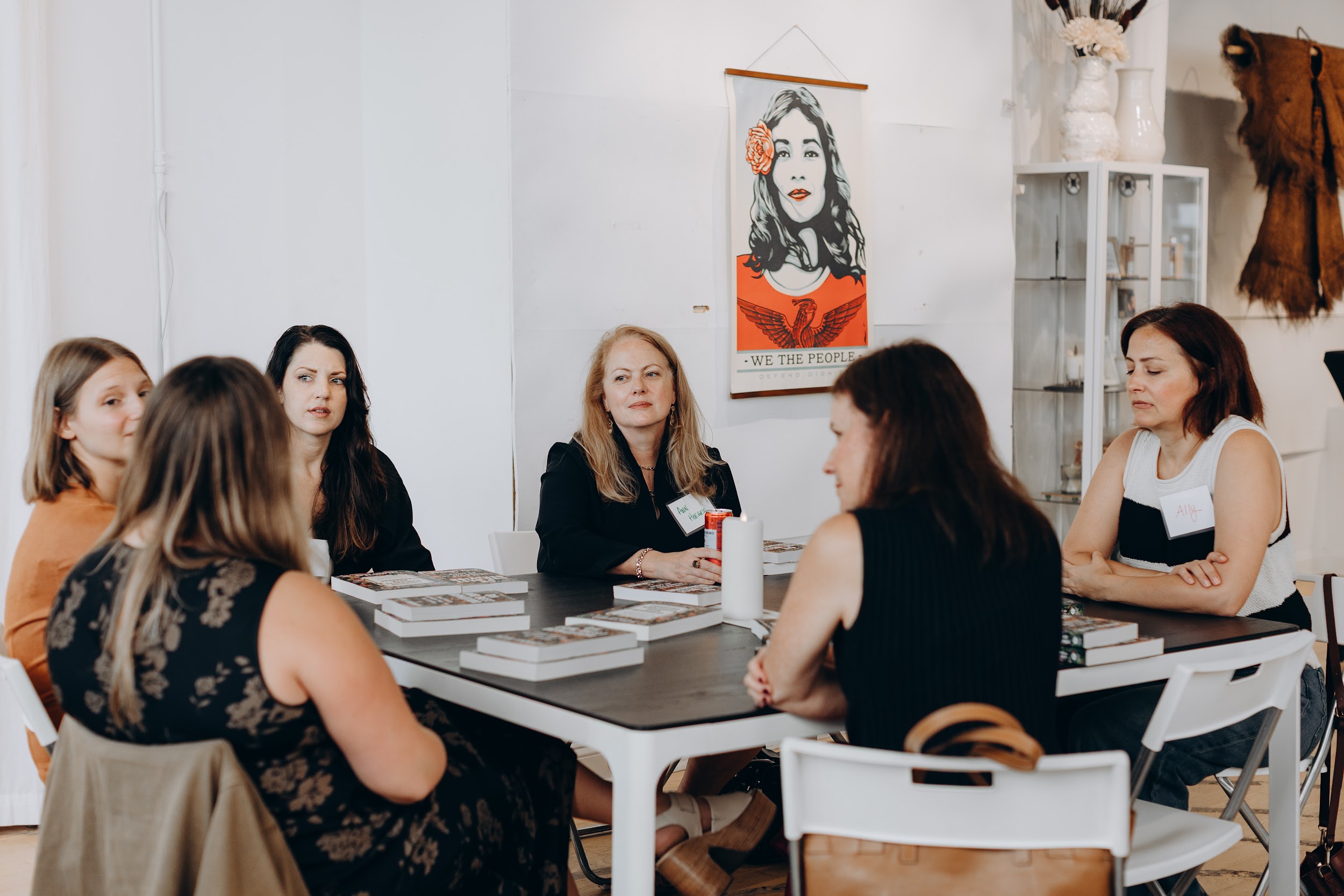
What does it mean to lead well when being “good” no longer works? This question sat at the center of a recent brunch conversation at ALTAR Community in Chicago, bringing women together for an intimate, candid exploration of leadership, self-trust, and inner alignment. In conversation with author and thought leader Elise Loehnen and moderated by Melissa Widen of First Women’s Bank, the gathering moved beyond a traditional author talk into something more reflective and participatory. It felt like a shared inquiry into how women lead, decide, and relate to themselves when old rules no longer fit. At the center was a simple but powerful reframe from Elise’s latest work: choosing wholeness over being “good.”

Why “Good” Stops Working
The conversation opened with a shared recognition: many women have been trained, explicitly and implicitly, to be good. Good colleagues. Good partners. Good leaders. Good daughters. Good friends.
As Elise Loehnen writes in Choosing Wholeness Over Goodness, this training asks us to disown parts of ourselves in service of approval. Reflecting on her earlier work, she notes that On Our Best Behavior named “everything that we’ve been conditioned to label as ‘bad’ and thus disown—our appetites, our need for recognition and rest, our desire to say what we really want, and feel, and think.”
The cost of this disavowal is not neutrality, but repression. “These natural human urges don’t go ‘elsewhere’ when we disavow them,” Elise writes. “We simply repress and suppress them in our bodies, and then ultimately project them onto other people.” Over time, this internal fragmentation can lead to burnout, self-abandonment, or a quiet sense of disconnection—especially for women in leadership who are expected to carry both competence and care.
Wholeness offers a different path. Rather than editing ourselves to be palatable or “appropriate,” it invites integration. As Elise puts it, wholeness is “large enough to contain every single part of us.” It allows ambition and uncertainty, strength and softness, and clarity and contradiction to coexist.
For many in the room, this reframing landed as both a relief and a challenge. What if leading well doesn’t mean being better behaved—but being more honest?
A Workbook Designed for Real Life
The conversation naturally moved into Elise’s workbook, Choosing Wholeness Over Goodness, which serves as a practical companion to her first book, On Our Best Behavior.
While On Our Best Behavior examines the cultural conditioning that shapes how women are expected to behave, the workbook is designed for application. Through specific tools, reflection exercises, and guided inquiry, it helps readers identify inherited rules, question internalized expectations, and notice where self-abandonment has become habitual.
Rather than offering answers, the workbook builds discernment. It strengthens the ability to listen inwardly and to choose from alignment rather than approval, an essential skill for grounded, sustainable leadership.

Separating Fact from Story
One of the most practical and widely relatable tools discussed was the distinction between fact and story. As Elise explores in the workbook, a helpful way to tell the difference is to ask whether the situation could be captured objectively, as if on video. If it cannot, it is likely a story.
Fact: You have not received a response to your email in three days.
Story: I did something wrong. They are upset with me. I am being avoided.
Fact: Your idea was not referenced during the meeting.
Story: My contribution was not valued. I should stop speaking up.
Fact: Another colleague was promoted.
Story: I am behind. I am failing. I should be further along by now.
Fact: You said no to an additional request.
Story: I am being difficult. I am letting people down. I am not a team player.
Naming the story does not mean dismissing it. It means creating enough clarity to respond with choice rather than habit. That pause between what happened and the meaning we assign to it is where better leadership decisions are made.

Why the Space Matters
The setting for the brunch was part of what made the conversation so impactful. Gathering at ALTAR Community created a thoughtful, non-performative space for reflection. Women listened closely, spoke honestly, and allowed complexity to exist without needing to resolve it.
Women-centered spaces like this are not a luxury. They are a necessity. They are where insight deepens, self-trust is rebuilt, and new ways of leading begin to take shape.
Choosing wholeness over goodness is not about abandoning care or responsibility. It is about leading from integration rather than compliance. For many who attended, the brunch was an invitation to keep asking better questions and to lead well from the inside out.
